

Roof guides
What actually happens during a re-roof, day by day
10 August 2026 · Scott Ryan
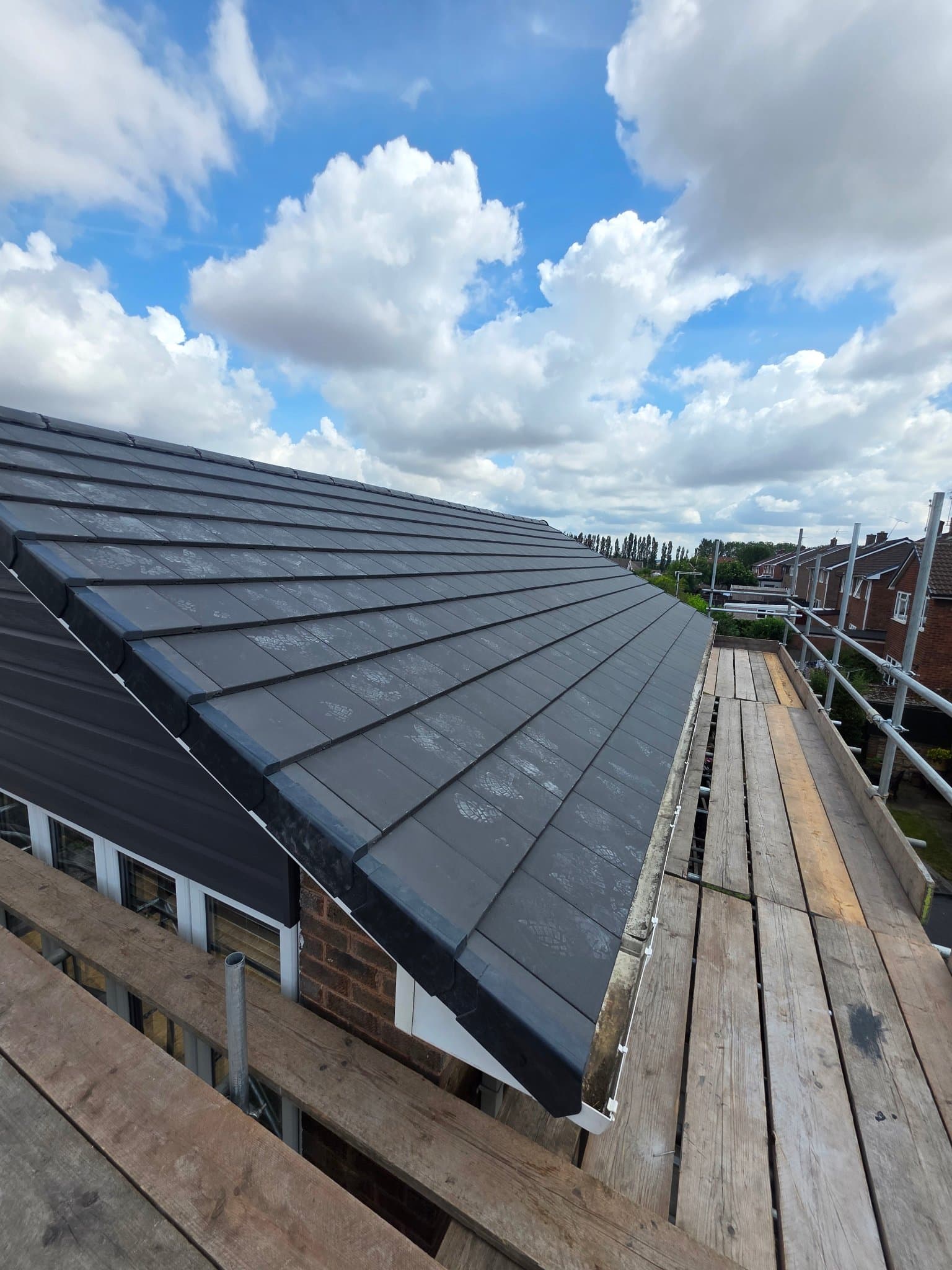
People ask us about price first and disruption last, when in our experience disruption is what they're actually worried about. Nobody has had their roof taken off before. You're picturing a hole in the top of your house, your loft full of rain, and a fortnight of banging.
So here's the whole thing, start to finish, from your side of the window.
The week before: scaffold
Scaffold usually goes up a day or two before we start — a different crew, a couple of hours, and nobody touches your roof that day. It's included in the price along with the skip and all the waste disposal, so there's nothing for you to book or pay separately.
What we'll ask you to do before day one:
- Clear anything precious from the loft, and cover what stays. Old roofs drop a surprising amount of dust and grit once the tiles come off
- Move cars off the drive, and tell us where the crew can park
- Pull garden furniture, pots and anything breakable back from the walls
- Take pictures down off the walls in upstairs rooms if they're hung on plasterboard — there's vibration
- Give the neighbours a heads-up, especially if the scaffold needs to sit near a shared boundary
- Keep pets in for the first hour of each morning while the crew are carrying up
Day one: the strip
This is the noisy day and there's no way round it. Tiles come off by hand, get passed down and go straight in the skip, then the old battens and felt come off behind them. A semi is usually stripped inside a day.
Two things surprise people. It's louder inside the house than outside — you hear it through the ceiling. And your loft will get dusty however carefully we work, because sixty years of grit sits on top of the ceiling joists and the moment the felt lifts, it moves.

What we find underneath
With the tiles off we can finally see the timbers. Most roofs are sound and we carry on. Sometimes we find rot at the eaves where guttering has been overflowing for years, a cracked rafter, or a wall plate that's gone soft.
If we do, we stop and show you — photos, in person, before we touch it — and price it before anyone agrees to anything. It's the one part of a re-roof nobody can quote for blind, and any roofer who tells you otherwise is guessing. It's also why we'd rather find it now than have you find it in five years.
Membrane and battens
New breathable membrane goes on, then new treated battens over the top, gauged to the tile. This is the stage that separates a re-roof from a re-cover, and it's the part you'll never see again once the tiles are on.
It's also where corners get cut in the trade. If a quote is noticeably cheaper than the others, this is usually what's missing — the tiles come off and go straight back on over the old felt. You're paying for a covering, not a roof. Worth asking any quoting roofer, in those words, whether the felt is being replaced.

Tiles, ridge and flashings
Then it's back up: tiles loaded out across the battens and laid course by course, ridge fixed, lead flashings dressed in around the chimney and any abutments, valleys formed. We fit dry-ridge systems — mechanically fixed rather than bedded in mortar — so you're not back to loose ridge tiles in a decade.
This is the long stretch and the quiet one. From inside the house you'll barely know we're there compared to strip day.
The last day
Gutters cleared of debris, the site brushed down, the skip goes, and we walk the whole job with you from the ground with the drone photos so you can see the finished roof properly rather than squinting at it. Scaffold usually comes down a day or two later.
You get your written guarantee, the manufacturer warranty on the tiles, and — on a full pitched re-roof — your building regulations certificate.

What people actually worry about
- "What if it rains half way through?" We only ever open up what we can close by the end of the day. The roof goes back weathertight every night. It's why a re-roof can look slower from the outside than you'd expect — and why your ceilings stay dry while it's going on
- "Will I have to be in?" No. Most of the work needs no access indoors at all, and we'll always ask first if we do need to come in
- "Is the scaffold a security risk?" It's a fair question on a quiet street. Keep upstairs windows locked while it's up — that's the honest answer
- "How bad is the dust?" Bad for one day, mainly in the loft. Cover anything up there you care about
- "What about my neighbours?" We'll speak to them ourselves if the scaffold or the skip affects them. It usually takes two minutes and saves a lot of bother
How long, and how much
Most semi-detached or terraced houses take four to six working days. A larger detached property is typically six to ten. Bad weather can pause us — we'd rather lose a day than lay a roof badly — but you'll get a realistic schedule before we start, not an optimistic one.
On price, most domestic re-roofs in our area land between £6,000 and £14,000, driven by size, the tile you choose and whether anything structural turns up underneath. Scaffolding, skip hire and waste disposal are in that figure. You get a fixed written quote within 48 hours of the survey.
The paperwork nobody mentions
Replacing more than 25% of a roof covering in England means the work has to comply with building regulations and be signed off — and usually brought up to current insulation standards at the same time. A roofer who can't self-certify has to involve building control, with the fees and inspections that brings, or skip it entirely. That one comes back to bite when you sell and the solicitor asks for the certificate.
We're registered with the NFRC Competent Person Scheme, so we self-certify our pitched re-roofs: compliance handled, certificate issued, nothing for you to arrange. If a re-roof quote says nothing at all about building regs, it's worth asking why.
Before any of that, a survey
Every quote starts with a free drone survey — every tile, ridge and valley photographed close up, and we go through the pictures with you. Plenty of the roofs we survey don't need replacing yet, and we'll tell you that too. NFRC CPS registered, £5m public liability, 10-year workmanship guarantee, and 19 years of Nottinghamshire roofs behind the advice.